
What the Bad Spaniels dispute—and its 2026 ruling—means for trademark infringement and dilution.
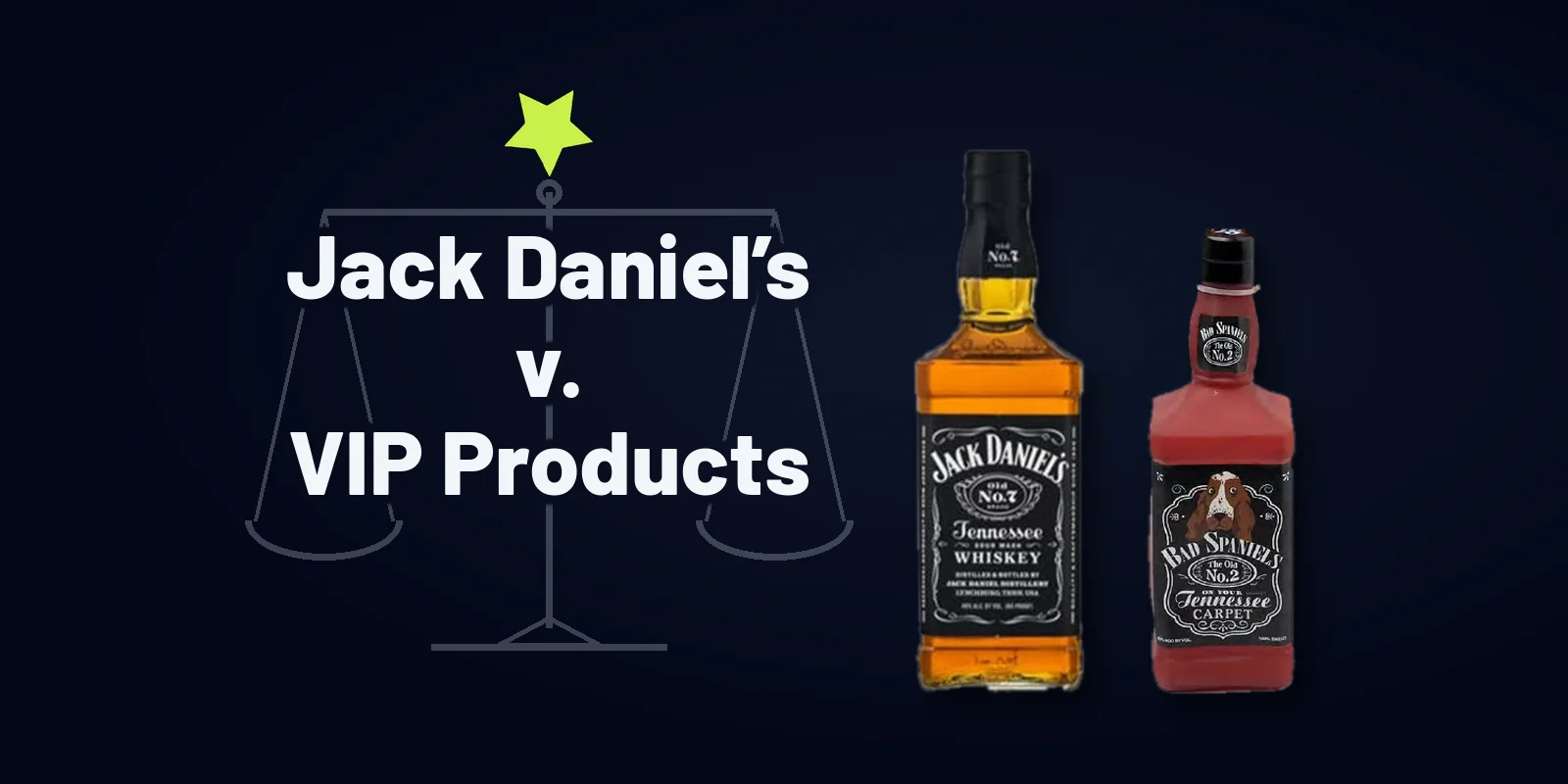
A squeaky dog toy copied the look of a Jack Daniel’s whiskey bottle. Its label replaced “Jack Daniel’s” with “Bad Spaniels” and “Old No. 7 Brand Tennessee Sour Mash Whiskey” with “The Old No. 2 On Your Tennessee Carpet.” The joke eventually reached the U.S. Supreme Court.
The case raises a practical question for anyone selling a product that pokes fun at a famous brand: Does calling something a parody protect you from a trademark claim?
The answer is that parody can matter, but it does not automatically protect a seller. In Jack Daniel’s Properties, Inc. v. VIP Products LLC, the Supreme Court limited certain defenses when a parody also serves as the seller’s own branding. The trademark owner still had to prove its claims. In 2026, the Ninth Circuit found that Jack Daniel’s had not proved its federal claim for dilution by tarnishment.
That distinction matters to both sides of a trademark dispute. A seller cannot rely on “it’s a joke” alone. A brand owner cannot rely on “it reminds people of us” alone.
How the Bad Spaniels trademark dispute began
VIP Products sold a dog toy shaped like a square liquor bottle, with a black label, white lettering, and decorative borders resembling those on Jack Daniel’s whiskey. It added dog-related jokes, including “43% POO BY VOL.” and “100% SMELLY.” The toy also carried a statement that it was not affiliated with Jack Daniel Distillery, as the Ninth Circuit’s 2026 opinion describes.
After Jack Daniel’s demanded that VIP stop selling the toy, VIP filed the lawsuit first. Its September 16, 2014 complaint in the U.S. District Court for the District of Arizona asked the court to declare that Bad Spaniels did not infringe or dilute Jack Daniel’s trademark rights. Jack Daniel’s responded with counterclaims, including trademark and trade dress infringement and dilution under federal and Arizona law. These were claims the court had to decide, rather than established wrongdoing. The district court’s 2025 findings and the Supreme Court’s opinion recount this procedural start.
The case involved more than the words on a label. It also concerned trade dress: the overall appearance of a product and its packaging. Here, that included the bottle’s shape and the arrangement of its label features.
Why using a parody as your own branding matters
A trademark helps customers identify where goods or services come from. A word, phrase, symbol, or design can perform that job, as the USPTO explains.
The same design can also make a joke. That overlap was central to this case. VIP’s amended complaint claimed trademark and trade dress rights in Bad Spaniels, and VIP acknowledged using the challenged features to identify its own product’s source. The Supreme Court treated that use as branding, even though it also communicated a parody.
In its unanimous June 8, 2023 decision, the Supreme Court held that the special First Amendment screening test known as the Rogers test does not apply when the challenged trademark use identifies the source of the seller’s own goods. The ordinary trademark infringement analysis applies instead. The Court also held that the dilution law’s noncommercial-use exclusion does not shield a parody when the challenged use serves as a source identifier. The federal dilution statute separately excludes fair use, including parodying a famous mark’s owner or its goods, but not when the mark is used as a designation of source for the user’s own goods. The district court had rejected VIP’s fair-use argument on that basis, and the Supreme Court relied on the same limit.
The Court’s decision was narrow. It did not decide whether the Rogers test is ever appropriate, or how far the noncommercial-use exclusion reaches. Nor did it decide that VIP ultimately owed Jack Daniel’s relief for infringement or dilution. It sent the case back for further proceedings.
For a business considering parody merchandise, the useful question is therefore more specific than “Is this funny?” It is also: Are we using the borrowed features to identify and sell our own product?
Trademark infringement and dilution ask different questions
Trademark infringement focuses on likely consumer confusion. Could buyers mistakenly think the product comes from, is sponsored by, or is approved by the trademark owner? The federal trademark statute frames this as confusion “as to the origin, sponsorship, or approval” of the goods.
Parody can affect that question. The Supreme Court explained that consumers may be less likely to think a brand owner is responsible for a product that mocks its brand. But that is something to consider in the confusion analysis, rather than an automatic exemption. In a concurring opinion, Justice Sotomayor added that in parody cases, courts “should treat the results of surveys with particular caution.”
Federal trademark dilution by tarnishment concerns likely harm to a famous mark’s reputation through an association created by a similar mark. It can apply even without likely confusion, competition between the products, or actual economic injury. The mark must meet the law’s demanding fame requirement: wide recognition among the general consuming public in the United States as a designation of source of the owner’s goods or services. See the federal dilution statute and the Ninth Circuit’s 2026 opinion.
Put simply, infringement asks whether people are likely to misunderstand the product’s connection to a brand. Tarnishment asks whether the relevant association is likely to damage a famous mark’s reputation. Winning on one question does not necessarily answer the other.
What happened in court
The dispute moved through the district court, the Ninth Circuit Court of Appeals, and the Supreme Court, then returned to the lower courts.
Case status checked October 7, 2026: The district court’s latest docket entry was October 6, recording the appellate mandate with the opinion attached. The judgment for VIP on federal dilution had already been entered September 29 (District of Arizona docket, No. 2:14-cv-02057-SMM).
Why Jack Daniel’s lost the federal dilution claim in 2026
The Ninth Circuit required proof tied to the particular famous marks and the particular alleged harm.
First, Jack Daniel’s could not treat every feature of its branding as independently famous. The record supported fame for the “Jack Daniel’s” mark and its registered trade dress, but did not independently establish fame for “Old No. 7.” Fame for one mark could not simply be borrowed to prove fame for another.
Second, the court found the evidence of likely reputational harm insufficient. Jack Daniel’s expert relied on general consumer psychology research about associating food or drink with feces. He had not conducted a study of Bad Spaniels specifically. His analysis also failed to account for the toy’s obvious parody and the fact that it was a dog toy rather than a product intended for human consumption.
The court did not make a consumer survey mandatory in every dilution case. Nor did it require proof of actual dilution or lost sales. It found that the evidence offered in this case did not prove likely harm beyond speculation. Parody remained relevant when deciding whether the trademark owner had proved tarnishment, even though VIP could not rely on the statutory exclusion.
The 2026 decision also did not resolve VIP’s constitutional challenge to the tarnishment provision. The court did not need to reach it after rejecting Jack Daniel’s claim on other grounds.
What businesses can learn from the Jack Daniel’s case
For a seller planning parody merchandise, review the whole presentation: the product name, design, packaging, and marketing. Consider how those features identify your product and whether buyers could misunderstand a connection to the brand being mocked. The fact that a product is humorous belongs in that analysis, but does not settle it.
For a brand owner considering a trademark claim, identify the exact rights at issue and the evidence supporting each claim. For federal dilution, the case illustrates why proof of a brand’s general popularity and an unwanted association must be connected to the statutory requirements for fame and likely reputational harm.
The Jack Daniel’s trademark case shows that a parody can lose a defense and still defeat a claim. For both creators and brand owners, the practical task is to examine the use, the applicable claim, and the evidence together.
If your business is planning a product that references another brand, or responding to a trademark demand, StarGuard Law’s trademark and brand dispute resolution services can help you assess the issues and available next steps.
This article is for general information only — not legal advice.