Startup Founders
Where You're Exposed
Startup founders face four pressure points before the first term sheet lands.
Each one shows up before there is a stack ready to handle it.
LOCKING IN THE BRAND
- The name has to be available federally, not just on GoDaddy.
- A registered domain is not a trademark.
- Founders learn this when a real owner sends a takedown letter.
- Rebranding after launch costs more than clearing the name first.
ASSIGNING IP TO THE COMPANY
- Code you wrote on your laptop is not the company's by default.
- Cofounders and contractors keep what they built without a signature.
- Investors check this on day one of diligence.
- A clean assignment file is what closes the round.
CLOSING THE FIRST ENTERPRISE DEAL
- The first enterprise customer sends paper, not a handshake.
- Their MSA puts the risk on you by default.
- Without a template to counter with, the founder signs whatever closes.
- The clauses that matter are the ones nobody pushes back on.
OPENING THE FUNDRAISE FILE
- The diligence checklist arrives before the term sheet.
- Investors check that every founder signed an IP assignment.
- Some tax filings have hard deadlines that cannot be extended.
- A clean file closes the round faster than the deck does.
A delayed term sheet is not the worst outcome.The worst outcome is the investor who walks because IP assignments are missing on the day diligence opens.
What You Actually Need
Investor-Ready Legal Foundation
The diligence file built before the term sheet arrives. Founder agreements with vesting, IP assignments signed by every founder and contractor, certificate of incorporation, bylaws, EIN, and a cap table that holds up under investor counsel review. The stack a clean Series A starts from.
Brand Locked at the Federal Level
Federal trademark filed before competitors notice the name. Pre-filing clearance across USPTO, all 50 state registries, common-law uses, domains, and social handles, with an attorney clearance opinion. Application drafted and prosecuted through to certificate. The brand stays with the company, not with whoever leaves first.
Contracts Built to Close
The MSA, NDA, and contractor templates that close enterprise customers and protect founder ownership. SaaS-side master service agreement and order form drafted in the company's name. Inbound enterprise paper redlined with leverage points named, indemnity and liability scoped to defensible positions before signature.
Embedded Counsel Through Series A
Ongoing legal coverage that scales with each milestone. A substitute for a full-time General Counsel at the cost a pre-seed budget can absorb. Continuous IP, contracts, and regulatory tracking across California, Ontario, and Quebec. Direct attorney access during the calls that matter, not a ticket queue.
How We Work Together
Free 15-minute discovery call.
We figure out whether SGL can solve your issue and whether we're the right fit.
No charge, no obligation.
Book a discovery callPaid strategy consult — 30 or 60 minutes.
Substantive legal advice scoped to your situation.
The fee credits toward your engagement if you hire us.
Book a strategy consultFlat fees. No surprises.
Every engagement scoped up front. No hourly billing. Direct attorney access.
Admitted in California, Ontario, and Quebec — the attorney on intake is the attorney at close.
Where to Start
Fractional Counsel
Embedded ongoing legal coverage across formation, IP, contracts, and fundraise prep. Without the cost or hiring lift of a full-time General Counsel.
ExploreNDA & Trade Secret Protection
Mutual and one-way NDAs, founder and contractor IP assignments with DTSA notice, and reasonable-measures memos that hold up across California, Ontario, and Quebec.
ExploreTrademark Search & Clearance
Pre-filing clearance across USPTO, all 50 state registries, common-law uses, domains, and social handles, with a written attorney clearance opinion.
ExploreTrademark Registration
Flat-fee USPTO registration: clearance, drafted application, prosecution through registration, certificate. The federal lock investors check.
ExploreSaaS & Enterprise Agreements
MSAs, SLAs, Order Forms, and SOWs drafted to close enterprise procurement. Inbound vendor and customer paper redlined with leverage points named.
ExploreContract Review & Negotiation
Plain-English risk memo, redlined contract with margin rationale, direct negotiation with counterparty's counsel through to execution.
Explore
Common Questions
Do I really need a lawyer to start my company, or can I use an online incorporation service?
Founders need both: an online filer for the certificate of incorporation, and an attorney to structure the company so it survives investor diligence. The cheap incorporation flow handles paperwork. It does not draft founder agreements with vesting, run IP assignment language past every contributor, set up an option pool that protects the founders, or flag the 30-day window for tax elections each founder must file. Diligence checks all of those.
Book a free discovery callWhat legal documents will investors expect to see before a seed round?
Investors expect a certificate of incorporation, founder agreements with vesting, IP assignments from every contributor, board consents, an EIN, and a clean cap table. They also review prior contracts, the option pool, and any side letters. Missing or sloppy documents extend diligence and tighten term-sheet language. The stack each investor's counsel runs is consistent across firms; the differentiator is whether yours is ready when they ask.
Book a free discovery callShould every cofounder sign a written founder agreement, or is a handshake enough?
A written founder agreement is the only document that survives the moment a cofounder leaves, gets fired, or wants to renegotiate equity. It locks in equity splits, vesting (usually four-year with a one-year cliff), single- or double-trigger acceleration, IP assignment, decision-making rules, and what happens if a founder departs. Handshake deals fail under the simplest stress test: ask each cofounder, in writing, what they think they get on day 365 if a key partner walks. The answers diverge.
Book a free discovery callWhy should my startup incorporate in Delaware as a C-corp instead of an LLC in my home state?
Most VCs only fund Delaware C-corporations, because Delaware's corporate code is the most established in the U.S. and its Chancery Court resolves disputes quickly. The Delaware Division of Corporations sets out the formation steps. C-corp tax treatment lets institutional investors (most of whom are partnerships or LLCs themselves) participate without complicating their own tax positions. LLCs, S-corps, and home-state corporations work for some businesses; they do not work for venture-backed scale. Re-incorporating later is costly. Form the company once.
Book a free discovery callWho owns the code if a cofounder leaves before the company is funded?
By default, the cofounder who wrote the code owns it; each founder must sign an IP assignment to the company for ownership to transfer. Copyright vests in the human author at fixation per the U.S. Copyright Office's Circular 1, and a corporate entity does not automatically own work its founders or contractors created. The remedy is a written assignment from every founder, contractor, and early employee that transfers all relevant IP to the company. Without it, a departing cofounder can claim the code, the architecture, or the brand.
Book a free discovery callWhat is an IP assignment agreement, and why does the company need one signed by every founder and contractor?
An IP assignment agreement is a written contract that transfers ownership of intellectual property from a founder, contractor, or employee to the company. Without it, the individual keeps what they built, and the company has no clean chain of title. Strong assignments cover code, architecture, designs, training data, prompts, model weights, and any pre-existing IP licensed in. Trade secret protection layers on top under the Defend Trade Secrets Act, which requires reasonable measures and gives the company a federal civil remedy if a trade secret is misappropriated.
Book a free discovery callWhat is a Section 83(b) election, and what happens if I miss the 30-day filing window?
A Section 83(b) election is a tax filing that lets a founder pay tax on restricted stock at grant value, instead of when each tranche vests. 26 U.S.C. § 83(b) sets the deadline at 30 days after the date of transfer, with no extensions and no administrative relief for late filers. At incorporation the stock is worth almost nothing, so the upfront tax is near zero; the savings compound as the company appreciates. Missing the window means every vesting event becomes a separate ordinary-income event at the then-current fair market value.
Book a free discovery callShould I file a federal trademark for my startup's name before launch, or wait until after fundraising?
Most founders should file before launch, because federal registration is the only signal that holds up against another company using a confusingly similar name. A registered domain is not a trademark; a state filing is not a federal lock; common-law rights are limited to where the brand is actually used. Pre-filing clearance is the cheap step. It covers USPTO, state registries, common-law uses, and domain layers. USPTO trademark basics walks the application stages.
Book a free discovery callDo I need an NDA before pitching investors, or is asking for one a sign of inexperience?
Most institutional investors will not sign an NDA at the pitch stage, and asking is widely read as inexperience. The convention is rooted in deal volume: VCs see hundreds of decks a quarter and cannot track which idea they heard from which founder. Reserve NDAs for vendors, contractors, advisors, and prospective acquirers: anyone with operational access to confidential information. The protection at the pitch stage is patent strategy, trade-secret discipline, federal trademark, and execution speed.
Book a free discovery callHow much equity should each cofounder get, and what is vesting?
Equal splits are common when contributions are roughly equal; weighted splits are common when one founder is full-time and another is moonlighting. Vesting is the mechanism that turns founder equity into earned equity over time, typically four years with a one-year cliff. The cliff means a founder who leaves in month nine forfeits all unvested shares; after month twelve, the first 25% is vested. Acceleration provisions cover what happens on acquisition. Vesting is non-negotiable for venture investors.
Book a free discovery callWhat is fractional general counsel, and when does a founder need one instead of hiring a law firm by the hour?
Fractional general counsel is a flat-fee monthly retainer that gives a founder ongoing access to a senior attorney, scoped to the company's actual legal volume. It works for companies that need recurring contract review, IP strategy, and regulatory questions answered, but cannot justify a full-time General Counsel. Hourly billing fits one-off matters; retainers fit continuous legal questions where the cost of re-briefing a new lawyer each time is high. Most founders cross the threshold around the first enterprise contract or first hire.
Book a free discovery callI'm a founder building an AI product. Should I lock down founder agreements and IP assignments first, or build out AI governance documentation?
Founder agreements and IP assignments come first, because investor diligence opens before the AI governance regulator does. If you are not yet shipping AI to EU users or regulated US sectors (employment, lending, healthcare, insurance), the priority is the formation stack. If you are already shipping AI in market, especially across borders, AI governance moves up the priority order. The AI & Generative AI Companies page covers that view. Either way, founder agreements and IP assignments are not optional.
Book a free discovery callI'm a Canadian founder incorporating in Delaware to raise from US investors. Where do I start?
Start with the founder agreement, IP assignment to the Delaware entity, and a tax-effective allocation of where US-Canada operations and revenue book. The cross-border layer (where to hold IP, where employees and contractors are based, where revenue books for tax purposes) is its own scope and is where most Canadian founders bleed value. The Cross-Border Canadian Tech Companies page covers the bi-jurisdictional layer in depth. StarGuard Law is admitted in California, Ontario, and Quebec, which is rare; one firm handles both sides without referring out.
Book a free discovery callInvestors arriving before your stack is ready?Lock it in.
Book a Strategy CallRelated Insights
 Trademark & Brand Protection
When a Rebrand Becomes a Trademark Lawsuit
The federal trademark dispute over the Beau Domaine skincare line began, according to the complaint, with a rebrand: two registered brands coexisted until one renamed its product line. The case shows why a rename, packaging refresh, or repositioning needs fresh trademark clearance even for an established business with its own registration, and why a registration is the start of the risk analysis, not the end of it.
June 11, 2026 Tech, AI & Privacy
The FTC Fined Three Companies Nearly $1 Million Over an AI Service That Didn't Even Work
On May 21, 2026, the FTC fined Cox Media Group and two partner firms a total of $930,000 over an AI 'Active Listening' service that never actually listened to anything. The detail that matters for legitimate AI companies is in the complaint: even if the product had worked, the consent framework would still have been illegal under Section 5 of the FTC Act. This article breaks down what the settlement signals for any company whose AI features genuinely collect and process user data, with five questions and three checks to run this week.
May 29, 2026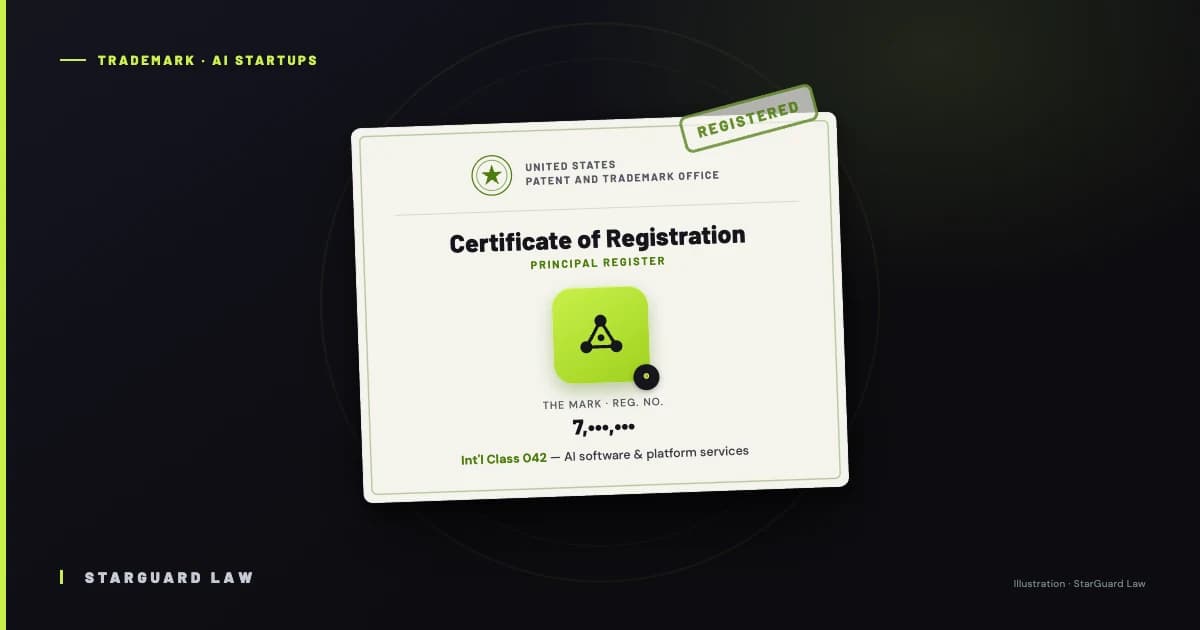 Trademark & Brand Protection
Trademark Registration for AI Startups: A Practical Guide
AI startups face three unique trademark risks: descriptive brand names that the USPTO rejects as generic, conflicts with established AI platforms, and international protection gaps when launching across borders. This guide walks through the five-step filing process used by StarGuard Law clients and flags the two mistakes that double the average time to registration.
April 22, 2026
